
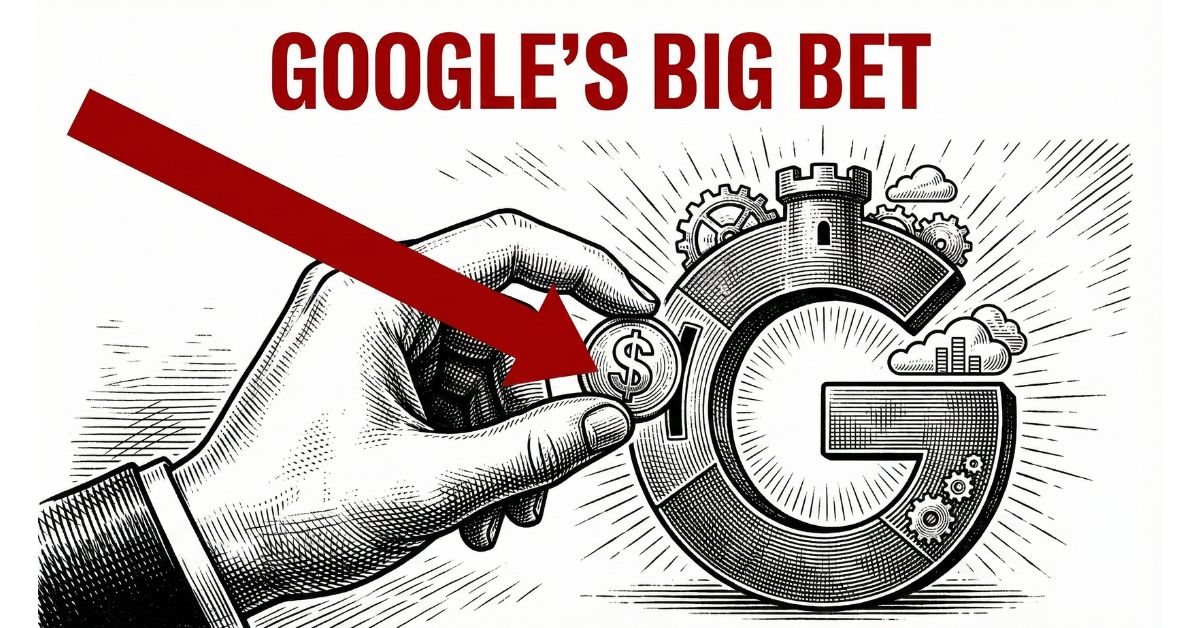
Everything you need to know about Alphabet earnings, GOOG stock price, and the future of AI infrastructure.
Quick Summary
- Google grew revenue 18% to $113.8 billion while already generating over $400 billion annually – a rare feat for trillion-dollar companies.
- Alphabet plans $175 billion to $185 billion in 2026 capex – nearly double 2025 spending – to build AI infrastructure moats before competitors catch up.
- Google Cloud revenue exploded 48% to $17.7 billion with a $240 billion backlog that doubled year-over-year, signaling years of locked-in demand.
- Search revenue grew 17% to $63 billion despite AI fears, proving AI Overviews and Gemini actually boost ad engagement rather than cannibalize it.
- Gemini now has 750 million monthly active users after adding 100 million in one quarter, with AI Mode queries three times longer than traditional searches.
- Google’s profit margin jumped to 30% with EPS growing 31% to $2.82 – showing massive scale and AI investments aren’t crushing profitability.
- TPUs give Google a cost advantage over rivals dependent on Nvidia GPUs, lowering AI serving costs by 78% through custom chip design and optimization.
- Apple chose Google Cloud as preferred provider – a major trust signal that validates Google’s enterprise-grade infrastructure and security.
- YouTube revenue surpassed $60 billion annually with AI-powered recommendations driving watch time and ad revenue despite a slight Q4 miss.
- Google owns strategic stakes in SpaceX (7%) and Anthropic (14%) – optionality that could deliver massive upside beyond core businesses.

Warren Buffett has a famous rule: “Be greedy when others are fearful.” Right now, Wall Street is fearful about how much money Google is spending. But the Google earnings report shows they are spending it to build an unbreachable “moat” around their business. Here is why the GOOGL earnings beat is the signal smart investors have been waiting for.
While everyone obsessed over whether the Google earnings beat expectations (they did, massively), the real story was buried in a single number that made veteran analysts nearly fall out of their chairs: $185 billion.
That’s how much Alphabet earnings will pour into AI infrastructure in 2026. To put it simply, Google just doubled down on a bet so massive it dwarfs anything we’ve seen in tech history. And here’s what nobody’s telling you: this might be the smartest move they’ve ever made.
Why the Google Earnings Beat Matters More Than You Think
Let’s cut through the noise. GOOG earnings crushed expectations across the board:
Revenue hit $113.8 billion (analysts expected $111.3 billion). That’s an 18% jump for a company already generating over $400 billion annually. Think about that. Google is growing faster now than when it was a fraction of this size.
Earnings per share came in at $2.82 versus the $2.63 estimate. Net income jumped 30% to $34.5 billion in a single quarter.
But here’s where it gets interesting. During my years working in finance, I learned to look past the headline numbers. The real story in GOOGL earnings is in three segments that reveal Google’s unstoppable momentum.

The Three Engines Powering Google’s Dominance
Search Revenue: The Cash Machine That Won’t Quit
Google stock price initially dipped after hours, and I couldn’t help but laugh. The market completely missed the point.
Search revenue grew 17% to $63 billion. Let me repeat that: seventeen percent growth on a $63 billion base.
Everyone keeps saying “AI will kill Google Search.” I recently wrote about this in my newsletter at TheFinanceNewsletter.com, and the data proves the opposite is happening. Google’s AI Mode and AI Overviews aren’t cannibalizing search traffic. They’re supercharging it.
Here’s what the earnings call revealed: daily AI Mode queries per user doubled since launch. These queries are three times longer than traditional searches. Translation? Users are asking Google more complex questions, spending more time engaged, and advertisers are paying premium rates for these high-intent searches.
Think of it like this: traditional Google Search was a vending machine. You put in a simple query, got a simple answer, done. AI Mode turned Google into a personal shopping assistant. You have a conversation, explore options, dig deeper. And every step of that journey creates monetization opportunities.
Google Cloud: The Sleeping Giant
This is where Alphabet stock believers get vindicated.
Cloud revenue exploded 48% to $17.7 billion. That’s not a typo. While Amazon and Microsoft are fighting tooth and nail for cloud market share, Google Cloud is quietly eating everyone’s lunch.
The NASDAQ GOOG listing should have soared on this number alone. Here’s why: Google’s cloud backlog doubled year-over-year to $240 billion.
Let me explain what a backlog means. It’s contracted revenue that hasn’t been realized yet because the infrastructure isn’t fully built. It’s like a restaurant with reservations booked solid for the next two years. The demand is there. The money is committed. Google just needs to build the capacity to serve it.
And that $185 billion capex? That’s exactly what they’re doing.
During my time analyzing tech companies, I saw Amazon build AWS from nothing into a cash-printing machine. The pattern is identical. High upfront investment, years of skepticism, then absolute dominance. Google Cloud is following the exact same playbook, just faster.
The AI Moat Nobody Talks About
Here’s what separates Google from every other AI player: they own the entire stack.
OpenAI needs Microsoft’s infrastructure. Anthropic needs Google’s TPUs (and Google owns 14% of them). Meta relies on Nvidia chips. But Google? They design their own AI chips (TPUs), run their own massive cloud infrastructure, and control their own AI models (Gemini).
This is like comparing a restaurant that owns its farm, supply chain, kitchen, and dining room to one that rents everything and buys ingredients at retail prices. Who do you think has better margins?
Gemini 3, released in November, outperformed ChatGPT and Claude on benchmark tests. The Gemini app now has 750 million monthly active users, up from 650 million just last quarter. And Google is integrating Gemini into every product they own: Search, YouTube, Cloud, Android, even Apple’s Siri.
The $185 Billion Question Everyone’s Getting Wrong
Wall Street freaked out when Google announced 2026 capital expenditures between $175 billion and $185 billion. Analysts expected $120 billion. Google nearly doubled that.
Stock dropped. Headlines screamed about “reckless spending.” But they’re missing the forest for the trees.
Here’s what the spending really means: Google sees something so valuable on the horizon that they’re willing to bet the farm on it. And they have the cash flow to do it without breaking a sweat.
Remember when Amazon poured billions into building fulfillment centers? Critics called it wasteful. Then Amazon turned logistics into an unbeatable competitive advantage. Or when Apple spent heavily to control its supply chain? Same story.
The pattern is simple: companies that invest heavily during technological transitions win the next decade.
Think of AI infrastructure like building highways in the 1950s. Expensive? Absolutely. Worth it? Look around. The companies that built the roads controlled where people traveled, where businesses located, where value accumulated.
Google is building the highways of the AI economy. Everyone else will pay tolls.
What Google Knows That You Don’t
The earnings call revealed something critical that most people glossed over. CFO Anat Ashkenazi said Google’s machine learning compute in 2026 will be split: just over half going to Cloud customers, the rest to internal use (DeepMind, Search improvements, advertising optimization).
This is brilliant. Google isn’t just betting on AI as a product to sell. They’re using AI to make their existing cash machines more profitable.
YouTube revenue ($11.4 billion) would have grown faster except they were lapping tough comparisons from election spending. But the real story is how Gemini is revolutionizing YouTube recommendations. Better recommendations mean more watch time. More watch time means more ads. More ads mean more money.
It’s a flywheel. And AI is the grease making it spin faster.
The Three Misconceptions Costing Investors Money
Misconception 1: “ChatGPT is killing Google Search”
The data says otherwise. Search revenue is accelerating, not declining. Google’s AI features are making Search more valuable, not less.
I predicted this months ago on my social media at @FluentInFinance. AI doesn’t replace search. It enhances it. Google understood this before anyone else.
Misconception 2: “The $185 billion capex is wasteful”
Only if you ignore the $240 billion cloud backlog. Only if you ignore the 48% cloud growth. Only if you ignore that Google generated $73 billion in free cash flow last year even while spending $91 billion on capex.
This isn’t reckless spending. This is strategic positioning.
Misconception 3: “Google is too late to AI”
Gemini 3 beat ChatGPT. Google controls the AI chips. They have the distribution (billions of users). They have the data. They have the infrastructure. Being second to market doesn’t matter when you have every other advantage.
Remember the iPod? Apple wasn’t first. Remember Facebook? MySpace existed first. First-mover advantage is overrated. Execution advantage is everything.
How to Think About Google Stock Right Now
The bull case: Google has multiple revenue engines (Search, YouTube, Cloud), all growing at double-digit rates. They control the AI value chain from chips to models to distribution. The $185 billion investment will pay off as cloud backlog converts to revenue and AI features drive engagement across all products.
The bear case: Capex is rising faster than revenue. AI could disrupt advertising. Regulators could force business changes. Competition is fierce.
Here’s my take after analyzing hundreds of tech earnings over 20 years: the market is underestimating Google’s position.
When a $2 trillion company grows revenue 18% while expanding margins and sitting on $127 billion in cash, you pay attention. When that same company controls critical AI infrastructure and has $240 billion in contracted cloud revenue, you really pay attention.
The Framework: How to Evaluate This for Yourself
Ask yourself these questions:
1. Does Google have competitive advantages that are growing or shrinking? Growing. TPU chip design. Gemini model performance. Cloud backlog. Search integration.
2. Is management allocating capital wisely? $73 billion in free cash flow says they can afford the investment. Cloud backlog justifies the spend. Track record is solid.
3. What’s the 5-year outlook? AI infrastructure becomes more valuable. Cloud continues taking share. Search adapts successfully. Multiple growth engines firing.
4. What’s the biggest risk? Regulatory action. But even the recent antitrust ruling was lighter than feared. Google avoided forced breakup.
5. Does the valuation make sense? At 31x P/E with multiple high-growth segments, it’s not cheap but not crazy for a quality compounder.
What This Means for You
I’m not telling you to buy Google stock. I’m not a financial advisor, and you need to make your own decisions based on your situation.
But I am telling you this: the artificial intelligence news coming out of Google’s earnings should make you rethink what you know about the AI race.
The companies winning the AI economy won’t necessarily be the ones with the flashiest chatbots. They’ll be the ones with infrastructure, distribution, and multiple ways to monetize.
Google has all three.
Final Thoughts
The Google earnings call revealed a company firing on all cylinders while making a massive bet on the future. Search is thriving. Cloud is exploding. AI is enhancing everything.
Wall Street got nervous about the spending. But spending isn’t the story. What they’re spending it on is the story.
In 2026, we’re witnessing the early innings of the AI infrastructure war. Google just showed up with a bazooka while everyone else brought knives.
The next few years will determine who owns the AI economy. Based on these earnings, Google isn’t just playing defense. They’re going on offense in a way we haven’t seen since the early cloud wars.
Pay attention to the companies investing heavily right now. They’re the ones that see what’s coming. And if history is any guide, they’re the ones that will profit when everyone else finally catches up.
Want to stay ahead of these market-moving developments? I break down earnings calls, economic trends, and investment insights at TheFinanceNewsletter.com and share real-time analysis at @FluentInFinance.
Google Earnings Breakdown
| Metric | Q4 2025 Result | Year-Over-Year Change | Why It Matters |
|---|---|---|---|
| Total Revenue | $113.8 billion | +18% | Accelerating growth at unprecedented scale |
| EPS | $2.82 | +31% | Profit growth outpacing revenue signals operating leverage |
| Net Income | $34.5 billion | +30% | Quality earnings, not accounting tricks |
| Net Profit Margin | 30.3% | +10% | Expanding margins while investing heavily is rare |
| Google Cloud Revenue | $17.7 billion | +48% | Fastest-growing major segment, becoming profit engine |
| Cloud Operating Margin | 30.1% | +12.6% | Margin expansion while scaling proves business model |
| Cloud Backlog | $240 billion | +100% | Multi-year revenue visibility justifies CapEx |
| Search Revenue | $63.1 billion | +17% | AI integration enhancing, not cannibalizing, core business |
| YouTube Ads | $11.4 billion | +9% | Lapping tough election comps; AI recommendations driving engagement |
| 2026 CapEx Guide | $175B-$185B | +97% | Offensive infrastructure build to capture AI demand |
| Free Cash Flow | $24.6 billion | -1% | Maintaining cash generation despite massive investment |
| Cash & Equivalents | $127 billion | Strong | Balance sheet supports aggressive spending without distress |
| Gemini App Users | 750 million MAU | +15% QoQ | Rapid consumer adoption of AI products |
| Waymo Valuation | $16 billion | Post-funding | Free optionality embedded in stock price |
| Strategic Stakes | SpaceX (7%), Anthropic (14%) | Strategic | Portfolio of AI/space upside at no extra cost |
FREQUENTLY ASKED QUESTIONS (FAQ)
What were the key highlights from the Google earnings call?
The Google earnings call revealed record-breaking performance across multiple segments. Google reported $113.8 billion in quarterly revenue (up 18% year-over-year), crushed EPS expectations at $2.82 (up 31%), and announced annual revenue surpassing $400 billion for the first time. The most shocking revelation was the 2026 CapEx guidance of $175-$185 billion, nearly double Wall Street expectations, signaling Google’s massive offensive bet on AI infrastructure.
Why did Google earnings beat expectations but the stock still dropped?
Markets initially panicked over the massive spending forecast, not the strong results. While GOOG earnings crushed revenue and profit estimates, the $185 billion CapEx guidance for 2026 (versus $120 billion expected) spooked short-term traders worried about margin compression. However, this spending is strategically sound: Google’s $240 billion cloud backlog and 48% Cloud growth justify the investment. History shows companies that invest heavily during platform shifts (Amazon’s AWS, Apple’s ecosystem) win the decade.
What is the difference between GOOG and GOOGL earnings?
GOOG and GOOGL are two share classes of Alphabet with identical financial performance. GOOGL (Class A shares) includes voting rights, while GOOG (Class C shares) has no voting rights. Both reflect the same Alphabet earnings results. For most retail investors, the voting rights don’t matter because founders control super-voting Class B shares. The stock prices are nearly identical, and you can choose whichever has better liquidity or pricing when you buy.
How fast is Google Cloud growing according to the earnings call?
Google Cloud revenue exploded 48% year-over-year to $17.7 billion in Q4 2025. This growth significantly outpaced Amazon AWS and Microsoft Azure in recent quarters. Even more impressive, Google Cloud’s backlog doubled to $240 billion, representing already-contracted future revenue waiting for Google to build capacity to serve it. Cloud operating margin also expanded to 30.1%, proving this segment is becoming a major profit driver, not just a growth story.
Is AI killing Google Search, or helping it?
AI is supercharging Google Search, not killing it, according to the earnings data. Search revenue grew 17% to $63 billion, accelerating from prior quarters. The Google earnings call revealed that AI Mode queries doubled, and these queries are three times longer than traditional searches, creating more valuable advertising opportunities. AI features are increasing engagement, time spent, and monetization per query. The fear that ChatGPT would replace Google Search is being proven wrong in real-time.
Why is Google spending $185 billion on CapEx in 2026?
Google is building AI infrastructure capacity to meet explosive demand and create a cost moat. The $175-$185 billion spending will fund data centers, TPU AI chips, power infrastructure, and networking equipment. With a $240 billion cloud backlog already contracted and 48% Cloud growth, the demand justifies the spend. Additionally, owning proprietary TPU chips reduces Google’s dependence on Nvidia and lowers long-term compute costs, creating a massive competitive advantage that competitors will struggle to match.
What does Google’s $240 billion cloud backlog really mean?
A $240 billion backlog means Google has already signed contracts for future cloud services that haven’t been delivered yet. Think of it like a restaurant with reservations booked solid for two years. The customers are committed, the revenue is contracted—Google just needs to build the infrastructure capacity to serve those workloads. This backlog doubled year-over-year, proving enterprise AI demand is real and accelerating. It also validates why Google is spending so heavily on CapEx: they’re building to meet committed demand, not speculative hope.
How is Google competing against OpenAI and ChatGPT?
Google has three major advantages over OpenAI: proprietary chips, cloud infrastructure, and distribution. While OpenAI depends on Microsoft’s infrastructure, Google designs its own TPU AI chips, runs its own massive cloud, and controls its own Gemini models. Most importantly, Google distributes AI through billions of daily users across Search, YouTube, Gmail, Android, and Chrome. The Gemini app now has 750 million monthly users, and Gemini is integrated into products used by billions. Google’s distribution moat is nearly impossible for startups to replicate.
What are the biggest risks to Google’s growth story?
The three main risks are: regulatory action, AI disruption of traditional search, and CapEx not paying off. Antitrust regulators could force changes to Google’s default search agreements, though recent rulings have been less severe than feared. AI could shift user behavior away from traditional search clicks, though current data shows the opposite. The biggest near-term risk is if the massive CapEx spending compresses margins without delivering corresponding revenue growth. However, the $240 billion backlog and 48% Cloud growth suggest the investment is justified.
How does Google’s profit margin compare to other tech giants?
Google’s 30% net profit margin is exceptional for a company its size, and it’s expanding. The margin improved by 10 percentage points year-over-year despite heavy AI investment, proving Google has operating leverage. For comparison, Amazon’s overall margin is lower (though AWS is highly profitable), Meta’s margin is similar, and Microsoft’s is slightly higher. What’s most impressive is that Google can invest $185 billion in 2026 and still maintain strong profitability and $73 billion in annual free cash flow.
What is Google’s AI advantage with TPU chips?
TPU (Tensor Processing Unit) chips give Google a massive cost advantage in AI. While competitors like OpenAI, Anthropic, and Meta depend on expensive Nvidia GPUs, Google designs and manufactures its own AI chips optimized specifically for training and running Gemini models. This vertical integration means Google has: lower cost per inference, no supply constraints from Nvidia, faster iteration on chip design, and better control over their AI roadmap. In AI, compute cost is everything, and owning your chips is a superpower.
How much free cash flow does Google generate?
Google generated $73.3 billion in free cash flow in 2025 despite spending $91 billion on CapEx. In Q4 alone, free cash flow was $24.6 billion. This massive cash generation is why Google can afford to nearly double its CapEx to $185 billion in 2026 without taking on dangerous leverage. The company ended Q4 with $127 billion in cash and equivalents on the balance sheet. This financial strength allows Google to invest aggressively in AI infrastructure while competitors face capital constraints.
What is Google’s relationship with Apple?
Apple chose Google Cloud as its preferred cloud provider, a major strategic win. This partnership means Google will help Apple develop “the next generation of Apple foundation models” based on Gemini technology. Additionally, Google pays Apple $20+ billion annually to be the default search engine on Safari. These partnerships give Google access to hundreds of millions of iPhone users and validate Google Cloud’s enterprise credibility. If Apple trusts Google infrastructure for its AI development, that’s a powerful signal to other enterprises.
Why does Google own stakes in SpaceX and Anthropic?
Google’s 7% SpaceX stake and 14% Anthropic stake provide strategic optionality and exposure to frontier tech. The SpaceX investment gives Google exposure to satellite internet (Starlink) and space infrastructure, which could complement Google’s cloud business. The Anthropic stake is even more strategic: Google supplies Anthropic with TPU chips and cloud infrastructure while gaining insight into cutting-edge AI development. These stakes are “free call options” on massive future markets that could each become multi-hundred-billion-dollar businesses.
How should investors interpret the CapEx increase?
The CapEx increase should be viewed as offensive strategy, not defensive panic. Companies that invest heavily during technological platform shifts—Amazon with AWS, Apple with chip design, Microsoft with cloud—tend to dominate the following decade. Google is betting that AI infrastructure will be as valuable as cloud computing or mobile platforms. With a $240 billion contracted backlog, 48% Cloud growth, and $73 billion annual free cash flow, Google has both the justification and the resources to make this bet. Short-term margin pressure is expected, but long-term value creation is the goal.
What segments are driving Google’s revenue growth?
Three segments are powering growth: Search & Ads ($82.3B, +13.5%), Google Cloud ($17.7B, +48%), and Subscriptions ($13.6B, +17%). Search remains the cash machine, generating over $63 billion quarterly with accelerating growth as AI features enhance monetization. Google Cloud is the growth star, nearly doubling year-over-year with a massive backlog. YouTube, part of the ads segment, generates over $60 billion annually across ads and subscriptions. The diversification across these segments makes Google far more than “just a search company.”
How is Google using AI to improve its core products?
Google is integrating Gemini AI across Search, YouTube, Gmail, Android, and Cloud products. In Search, AI Mode provides conversational answers while maintaining ad monetization. In YouTube, Gemini powers better recommendations, increasing watch time and engagement. In Cloud, enterprise customers use Gemini for code generation, customer service automation, and data analysis. Over 8 million paid Gemini Enterprise seats have been sold to 2,800+ companies. The strategy isn’t “AI as a separate product”—it’s “AI making every existing product better and more valuable.”
What should investors watch for in the next Google earnings call?
Track five key metrics: revenue growth rate, Cloud growth and backlog, operating margin, free cash flow, and Search trends. If revenue growth stays in the high teens, Cloud maintains 30%+ growth, operating margin holds despite CapEx, and free cash flow remains strong, the thesis is working. Warning signs would be: Cloud growth dropping sharply, Search revenue turning negative, margins compressing more than expected, or free cash flow deteriorating significantly. Also watch for updates on Gemini adoption, TPU deployment, and major cloud contract wins.
Is Google a good investment after these earnings?
I can’t tell you whether to invest (I’m not a financial advisor), but I can share the framework. Bull case: multiple revenue engines growing double-digits, AI infrastructure advantages, $240B contracted backlog, vertical integration from chips to distribution, strong cash generation. Bear case: regulatory risk, CapEx could compress margins, AI could disrupt ad model, competition is fierce. After 20 years analyzing tech, I see a company with rare scale, diversification, and positioning during a platform shift. Whether that fits your portfolio depends on your time horizon, risk tolerance, and conviction level.
Where can I get ongoing analysis of tech earnings and market trends?
I break down earnings calls, economic trends, and investment insights at TheFinanceNewsletter.com with over 100,000 subscribers who want clear, actionable financial analysis without the jargon. I also share real-time market analysis and artificial intelligence news at @FluentInFinance across social platforms with 3+ million followers. My goal is making complex financial concepts accessible while providing sophisticated analysis backed by 20 years of Wall Street experience at firms like Goldman Sachs, JPMorgan, and Citi.
